












Topeka gave me wings.
If asked to name a city in Kansas associated with aviation, most people would say Wichita, but Topeka has a rich aviation history that is not as well known. It took time for me to find out.
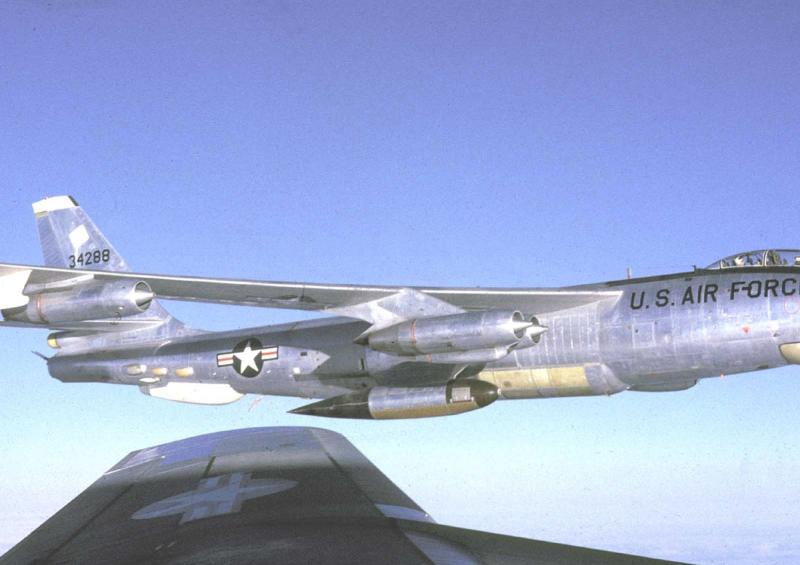
My father got me hooked by building a succession of small models of the Curtiss P-40, a fighter used in World War II and made famous by the Flying Tigers in China. I loved the shark mouth decals on the nose, but I broke them, so he built more! I grew up watching “Sky King,” “Ripcord” and “Whirlybirds.” Growing up in the Highland Crest neighborhood a bit north of Forbes Air Force Base, now Topeka Regional Airport, I watched sleek Boeing RB-47s on landing approach, towing a drogue chute, which allowed the crew to maintain power on the small, unreliable jet engines of the time.
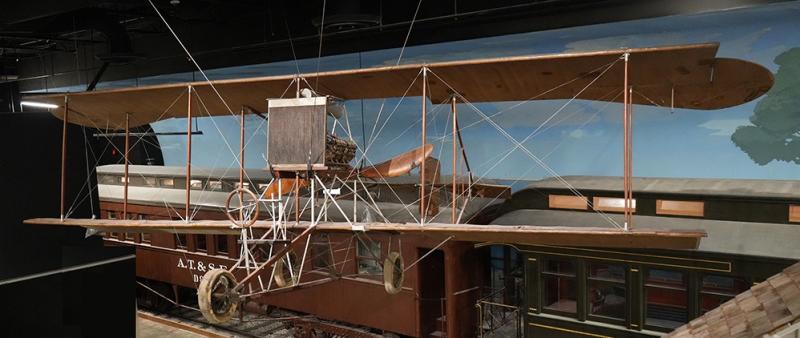
During a school field trip to the Kansas History Museum, which at the time was located downtown on 10th Street, I saw an early biplane and was surprised to learn it was built in Topeka. I later learned that Albin Longren had seen a Curtiss biplane, built one himself and became the first Kansan to build and fly an airplane in Kansas. He flew from a field just south of 53rd Street and west of Berryton Road on September 2, 1911; a small sign marks the spot today.
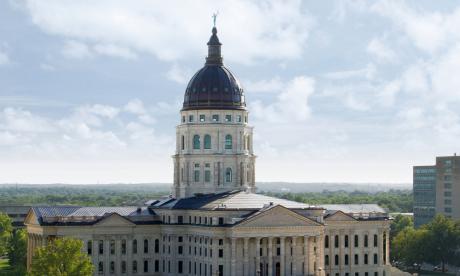
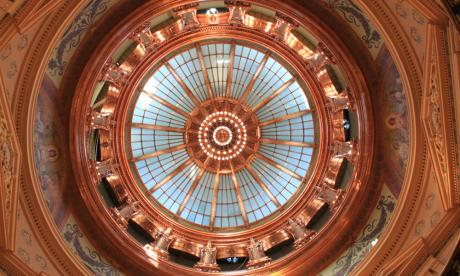
Longren built and sold several aircraft, some to Phil Billard, the son of Topeka’s mayor, Julius Billard. Billard flew from a place he called “Aviation Hill,” located east of Lake Shawnee, which didn’t exist at the time. A newspaper article described how Billard would fly around the base of the dome of the Capitol Building!
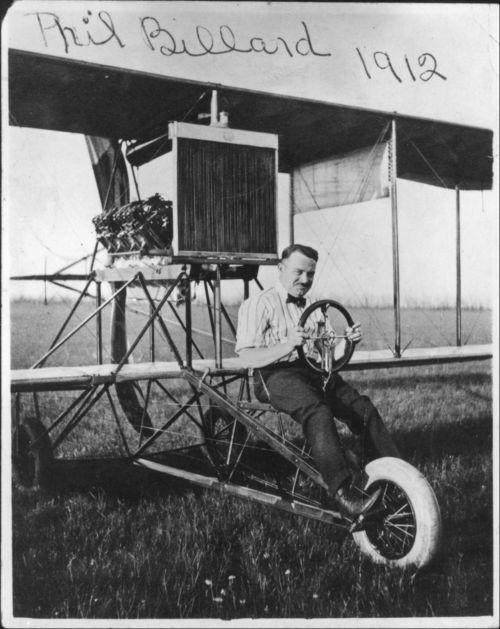
Billard joined the Kansas National Guard and used his own airplane to begin training pilots and mechanics to prepare for America’s entry into World War I. When America finally went to war, all National Guard aviation units were closed and their personnel transferred into the Army Air Service. Regrettably, Billard lost his life in a crash while test flying an aircraft after his passenger fainted and fell against the control stick. Topeka Municipal Airport was renamed Philip Billard Airport in 1940.
Donald Hudson was born in Topeka in 1895 and joined the Air Service. He flew with the 27th Aero Squadron in France during the war and downed six German aircraft. He went on to help pioneer aviation in South America after the war.
Pilots began flying from a farm just east of Pauline on 61st Street in 1916; ten years later, a gentleman named Ray Morris opened a flight school at the field. I had heard of an airport near Pauline and finally found an aeronautical map dated 1932 that showed a “Marked Auxiliary Field” at this location.
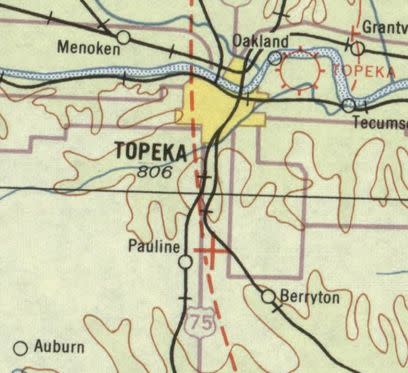
Charles Lindbergh’s solo flight across the Atlantic set off a nationwide aviation craze and every town had to have an airport. A group of people led by a Mr. Rooney rented some land east of the Oakland neighborhood from a Mr. Pugh and established “Topeka Airport – Rooney Field.” Once the Depression wrecked the economy in 1930, Rooney quit and Pugh continued to run the airport. The city of Topeka bought the land from Pugh in 1932 and established Topeka Municipal Airport in 1932, with new, longer runways. The original runways from Rooney Field are visible today in overhead images of the airport and appear as a small, inverted V north of runway 13/31 and west of the abandoned northeast/southwest runway. The Works Project Administration built the lovely stone hangar at Topeka Municipal Airport in 1939, and the airport was dedicated and renamed Philip Billard Municipal Airport in 1940. Once World War II began, the U.S. Army made many improvements at Billard Airport and Braniff, Continental and TWA all began airline service to Billard in 1944.
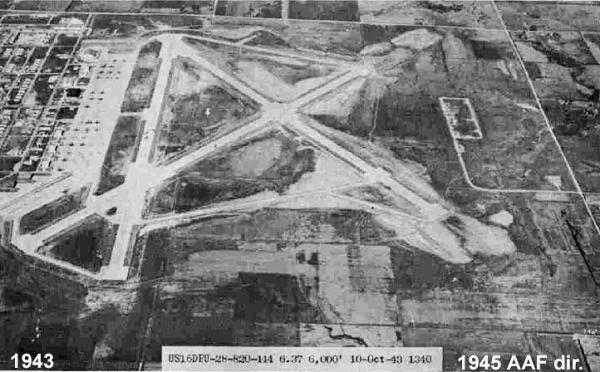
A month after the Japanese attack on Pearl Harbor, the U.S. Army Corps of Engineers arrived in Pauline, drove a bit east of the grain elevator, snipped at the barbed wire fence on the south side of 61st Street, and parked a trailer inside the wire. Construction of Topeka Army Air Field (TAAF) had just begun. By August, crews of both B-17 Flying Fortress and B-24 Liberator heavy bombers began their 30-day courses of training before going to war. Later in the war, B-29 Superfortresses replaced the other bomber types. The large supply depot across the highway also supported modification programs for the aircraft during their short visits to TAAF.
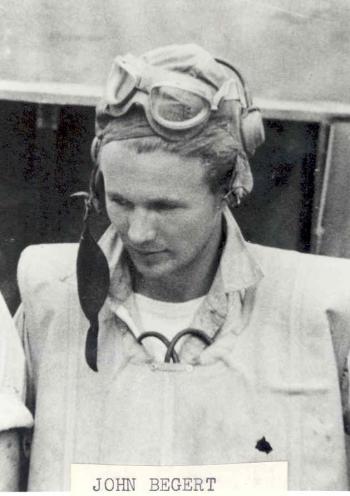
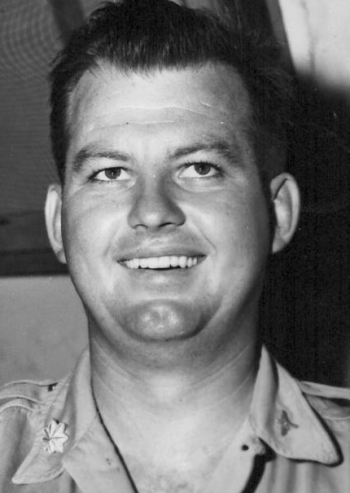
Several Topekans made a name for themselves in the air during World War II. William Knight and Willam S. “Bubblehead” Price, III, completed flight training at Tuskegee Army Air Field during the war; Price was credited with downing a Messerschmitt Me-109 on March 16, 1945. John Begert graduated from Topeka High, attended the University of Kansas and joined the Marine Corps. He became a fighter pilot and flew with VMF-214, the famous “Black Sheep Squadron” led by Gregory “Pappy” Boyington. Begert was credited with destroying three Japanese aircraft, two on one mission on his second day of combat.
The war ended in 1945 but TAAF remained very busy; it became an air transport hub for military aircraft flying across the nation. The base closed in 1947 and the hangars were used to store a bumper crop of wheat. The airfield reopened in 1948 as a Strategic Air Command (SAC) base and a year later was renamed Forbes Air Force Base (FAFB) after Daniel Forbes, born nearby in Carbondale, Kansas. Forbes, his copilot and three others died in the crash of their Northrop XB-49 Flying Wing in a flight test mishap. After another brief closure, Forbes reopened in 1951, again as a SAC base. The base expanded to allow the extension of the northwest /southeast runway to 12,800 feet to accommodate the arrival of the Air Force’s first swept wing jet bomber, the Boeing B-47 Stratojet. Forbes became home to two units, the 55th and 90th Strategic Reconnaissance Wings (SRW) and later, the 40th Bombardment Wing. The 55th SRW deployed to many places around the world where they would fly missions deep into Soviet airspace, recording radio and radar frequencies, response times of Soviet fighters and other details. The Soviets often intercepted and shot at the American aircraft, and downed one Forbes jet over the Barents Sea in 1960. Four crewmembers were lost while two survived and were captured by the Soviets, who later exchanged them for some Soviet spies held by the United States. Major Palm Park on SW 37th Street in Topeka is named for the aircraft commander who did not survive the encounter.
Forbes hosted several Atlas nuclear-armed intercontinental ballistic missile sites around Topeka from 1961 to 1965. A new command and new aircraft replaced SAC and the Stratojets in 1966. Tactical Air Command gained FAFB and large Lockheed C-130 Hercules cargo aircraft soon filled the skies over Topeka. My friends were mostly Air Force brats and they talked about their fathers going “TDY to Vietnam”: temporary duty to a country most of us had never heard of.
During this time, two more Topekans made their mark in military aviation history.
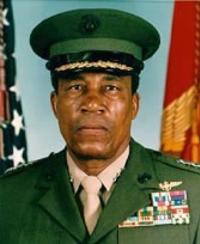
Frank Petersen, Junior, grew up in Topeka and loved to watch the aircraft from Topeka Army Air Field flying over his house. After graduating from Topeka High in 1949, he spent a year at Washburn University before he enlisted in the Navy. Lieutenant Jesse Brown was the Navy’s first black fighter pilot, who died after being shot down in Korea in 1950. After Frank heard Brown’s story, he inquired into flight training; he was accepted and became the first black aviator in the Marine Corps. Frank found himself flying combat missions in Korea, commanded a fighter squadron in Vietnam and retired in 1988 as a three-star general and the senior aviator in both the Marine Corps and the Navy. Frank passed away in 2015. The Navy commissioned the USS Frank E. Petersen Jr., an Arleigh Burke-class destroyer, in 2022.
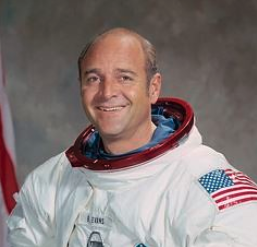
Ron Evans graduated from Highland Park High School in 1951 and, five years later, graduated from the University of Kansas and joined the Navy. He became a naval aviator in 1962. In 1966, NASA selected him to be an astronaut in the Apollo program, but he had to complete his combat tour in Vietnam first! Ron, Gene Cernan and Harrison Schmitt crewed the last moon landing in Apollo 17 during December 7-19, 1972. Ron was the command module pilot and continued orbiting the moon while the other two landed and walked on the moon. Evans was the last person to orbit the moon alone and still holds the record for more time in lunar orbit than anyone else. Ron retired from NASA in 1977 and passed away in 1990 at the age of 56.
As America began winding down the war in Vietnam, the Pentagon began reducing the size of the nation’s military and the number of its military bases. Forbes Air Force base closed in 1973, and local governments formed the Metropolitan Topeka Airport Authority to manage both Forbes Field and Billard airports, along with related properties. The 190th Tactical Reconnaissance Group of the Kansas Air National Guard moved from Hutchinson to Topeka in 1967 and was able to move into the hangars and property at the north end of Forbes after the Air Force departed. The 190th flew several variants of the Martin B-57 Canberra until 1977, when they converted to Boeing KC-135A Stratotankers and became the 190th Air Refueling Group. Nearly 50 years later, they fly the much-improved KC-135R at the 190th Air Refueling Wing.
The Kansas Army National Guard had operated from Billard Airport for many years but outgrew their small brick hangar when they gained Sikorsky CH-54 Tarhe heavy lift helicopters, better known as Skycranes, in 1973. Army Aviation Support Facility #1 transferred to Forbes Field shortly afterward. The unit later flew Bell UH-1H Huey helicopters and finally gained Sikorsky UH-60 Black Hawk helicopters, which they operate today.
After I graduated from Highland Park High School in 1975, I attended a school in Kansas City where I learned to be an aircraft mechanic. After passing the Federal Aviation Administration exam, I received my Airframe and Powerplant Mechanic license and then really began to learn. After working several years for aviation operations in Kansas City and Dodge City, I returned to Topeka and went to work for Mid-America Aviation at Forbes Field. Mid-America was the only fixed base operator at Forbes at the time, providing fuel, maintenance, aircraft storage and any other services required by visiting aircraft and crews. They also ran a flight school and offered aircraft to rent. The four partners treated their customers and employees like family, and when they learned that I had begun flying lessons in Kansas City but stopped due to the cost, they told me to finish my training and pay them when I could…agreed over a handshake, not a contract. Thanks to them, I completed my training and received my private pilot’s license.
I joined the 190th Air Refueling Group in 1984 and spent the next 30 years helping to maintain the unit’s Stratotankers. Deployments with the 190th took me to many places around the world, including stops in Saudi Arabia during Desert Storm and Iraq during Iraqi Freedom. I’ve been working on aircraft in the local area for years and continue to do so, but after retiring from the Air National Guard, I became the director of the Combat Air Museum in 2016. We have 47 aircraft in two hangars and many displays which explain the history and evolution of aviation. Youth aviation education is my favorite activity, whether it’s teaching an Aviation merit badge class with an overnight stay at our museum, running our two Young Aviators summer camps, or my favorite, Girls in Aviation Day, which will be held this year on Saturday, September 12.
Topeka has several avenues for people to learn more about flight training and aviation.
Aviation Explorer Post 8 has been teaching Topeka youth to learn to fly for decades. Located in Hangar 15 at Billard Airport, Post 8 accepts students who are interested in learning to fly, are at least 14 years old and have graduated eighth grade. Their program teaches everything needed to achieve a private pilot’s license, from passing the written exam, to flight training with, in my opinion, some of the best flight instructors I’ve ever met. More importantly, the youth run the post under the supervision of adult advisors, which imparts character and leadership upon the students. Learn more about Aviation Explorer Post 8 at www.post8.org or on Facebook at https://www.facebook.com/AEPost8.
Most Topeka high schools offer Junior Reserve Officers’ Training Corps (JROTC) classes associated with the various military services. A young man who attended Washburn Rural High School and was involved in that school’s Air Force JROTC course also volunteered at the Combat Air Museum. Last summer, he graduated from the United States Air Force Academy and is now undergoing pilot training.
After several years without, Topeka has a flight school and aircraft rental available again. Top Aviation Services is also at Billard Airport in Building 4 and offers a range of flight training, from sport pilot to commercial licenses, with instrument flight and tailwheel ratings. They have several aircraft available to rent. Learn more at https://goflytopeka.com/programs/ or find them on Facebook.
Aviation is a fascinating and multi-faceted career for pilots, mechanics, air traffic controllers, engineers and many other fields. It has literally taken me around the world over the last five decades, but I got my start in Topeka.
